Almost every “best matcha for beginners” list online is written by a shop that sells matcha. This one is not. Below is the short answer, then the reasoning, including the price floor below which a tin almost certainly is not what its label says.
The short answer
Buy 20–30 g of first-harvest Japanese ceremonial matcha that names its prefecture on the pack, and expect to pay ₹23–37 per gram in India — the mid band in the table below — or $0.90–1.60 per gram internationally. Do not start with a 100 g bag: matcha oxidises within weeks of opening, and a beginner will not finish it while it is still good. Do not start with culinary grade if you intend to drink it with water. In India, the most defensible first tins are Noon and Yūzen Nami for drinking straight, and Teabox if you want the lowest risk on price.
Why price per gram is the only number worth comparing
Matcha is sold in tins of 15 g, 20 g, 25 g, 30 g, 50 g and 100 g, which makes headline prices meaningless. A ₹445 tin and a ₹958 tin from the same brand can cost the same per gram. Every price on this site is therefore divided by pack weight before anything is compared.
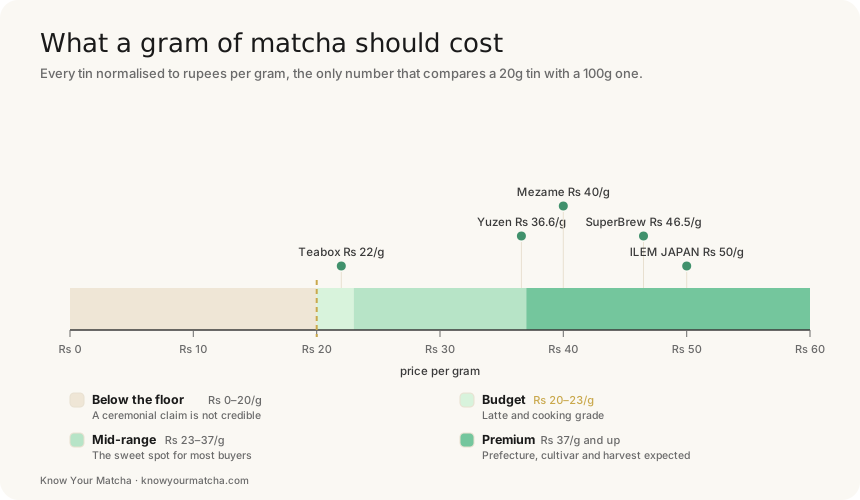
Doing that across the 14 brands on our India ranking produces three bands. They are descriptive, not aspirational. This is what the Indian market actually charges.
| Band | Price per gram | What it realistically is |
|---|---|---|
| Below ₹9/g | < ₹9 | Later-harvest culinary powder, often not single-origin. Fine in a sweetened latte. Will taste bitter and flat whisked with water. |
| Budget | ₹9–22/g | Honest everyday matcha. Best value sits at the top of this band. Suitable for lattes and forgiving enough to learn on. |
| Mid | ₹23–37/g | Where genuine first-harvest ceremonial grade starts to appear with real provenance. The right band for a first tin you intend to drink straight. |
| Premium | ₹38–50/g | Single-cultivar, named-farm, JAS-organic. Real differences exist here, but they are differences a beginner is not yet equipped to taste. |
The floor. Ceremonial-grade matcha requires first-harvest tencha, de-stemming, de-veining and stone milling at roughly 30–40 g per hour per mill. That cost structure does not survive a retail price under about ₹20 per gram in India or $0.60 per gram internationally. A tin labelled “ceremonial” or “AAA” below that floor is making a claim nobody audits. “Ceremonial” is not a regulated term. No body in Japan or elsewhere certifies it, not the Japan Tea Central Association, not the FDA, not FSSAI.
The Forgiveness Index
The real beginner problem is not finding the finest matcha. It is that good matcha punishes bad technique. Water at 95 °C instead of 70–80 °C, no sifting, or a spoon instead of a whisk will make an expensive tin taste worse than a cheap one. So the question is not “which is best” but which is hardest to ruin.
We score that from four attributes a brand either discloses or does not. It is a disclosure-based index, not a taste score, and we say so plainly, because the difference matters.
| Attribute | Forgiving | Unforgiving | Why |
|---|---|---|---|
| Harvest | First harvest (ichibancha) | Second or third, or undisclosed | Later harvests carry more catechins relative to amino acids, so errors read as bitterness sooner. |
| Grind | Stone-milled, 5–10 microns | Machine-ground or undisclosed | Finer particles suspend with less whisking, so a weak whisk still produces a drinkable bowl. |
| Pack size | 20–30 g | 100 g+ | A beginner takes months to finish 100 g. Most of it will be stale before it is drunk. |
| Cultivar | Named and naturally sweet (Okumidori, Saemidori) | Undisclosed blend | Naturally sweeter cultivars mask technique errors. An undisclosed blend is a lottery. |
A brand scoring four out of four is a safe first purchase almost regardless of price band. A brand scoring one or two may still be excellent matcha. It is simply a worse first tin.
What this index is not. It measures what a brand is willing to tell you, which correlates with but is not identical to quality. A brand can disclose everything and still make mediocre matcha. Blind tasting is the only way to settle that, and our tasting programme is in progress. See how we test. Products we have not tasted are marked Not yet tested and are not given a flavour score anywhere on this site.
Two paths to a first tin
Path A: “I want to find out if I like matcha”
Budget ₹550–900 total. Buy a 25–30 g tin in the budget-to-mid band, a ₹150 bamboo whisk, and use a small bowl you already own. If you dislike it, you have spent the price of two café lattes. From our India ranking, Teabox (₹549/25 g, ₹22/g, Shizuoka, source-packed) is the lowest-regret entry, shade-grown tencha, radiation-free certified, and cheap enough that a mistake costs you the price of two café lattes. Bree is the other option worth a look: its 30 g range runs ₹16–43/g depending on SKU, so you can start at the bottom of the ladder and move up within one brand.
Path B: “I already know I like it, start me properly”
Budget ₹1,400–1,900. Buy a 30 g first-harvest ceremonial tin with named origin, plus a proper chasen and a chawan. Noon (₹1,290/30 g, JAS-organic, single-origin Kagoshima, first-harvest Yabukita) discloses more than anything else at its price. ILEM JAPAN (₹1,250/25 g, ₹50/g) is the strongest all-rounder on our ranking but sits at the top of the premium band.
A third option, added August 2026
Yūzen Nami (₹1,099/30 g, ₹36.6/g, falling to ₹31/g at 100 g) belongs in the mid band alongside Path A and B. It is first-flush Uji tencha with a disclosed cultivar blend (80% Okumidori), and Yūzen discloses more about what is in the tin than any other brand we have audited in India, prefecture, harvest, cultivar and milling method, all stated. It publishes named-laboratory pesticide and microbiology reports, which nobody else here does, though it does not publish heavy-metal results. It has no customer reviews yet, so we cannot triangulate our impression against anyone else's. Yūzen supplied this sample free of charge; see the full entry and disclosure.
If you are buying to make lattes only
Then ignore both paths and buy culinary or premium grade in volume. Heapwell starts around ₹9/g, the lowest defensible cost per gram we have found in India. Milk and sweetener flatten the differences that ceremonial grade is paying for. Spending ₹50/g on a latte is money burnt.
Five mistakes that are worth more than brand choice
- Boiling water. Use 70–80 °C. Boiling water scalds the powder and produces bitterness that no brand can survive. Boil, then wait three minutes.
- Not sifting. Matcha clumps in the tin. Unsifted clumps do not disperse and leave bitter pockets. A tea strainer works.
- Buying 100 g. Matcha degrades within four to eight weeks of opening. Buy small, finish it, buy again.
- Storing it wrong. Airtight, opaque, cool, away from the hob. Not the fridge door, where condensation cycles in and out.
- Judging on the first bowl. Your first three bowls are measuring your technique, not the matcha.
Buying internationally
Outside India the same logic applies with a different floor: roughly $0.60/g before a ceremonial claim becomes implausible, and $0.90–1.60/g for a credible first tin. The brands that recur most consistently across independent 2026 roundups are Ippodo and Marukyu Koyamaen at the traditional Uji end, Encha and Naoki in the organic single-origin middle, and Jade Leaf as the widely stocked entry point. We list these because they are the market’s consensus, not because we have tasted them, that distinction is the whole point of our methodology.
What to read next
- Best matcha brands in India, all 14 brands with price per gram computed.
- Ceremonial vs culinary grades, what the grade words do and do not mean.
- Budget finder, filter by what you actually want to spend.
- Matcha cafés, taste it before you buy a tin.
- How to make matcha, so the first tin does not get wasted on bad technique.
- What the colour of the powder tells you, the fastest check on a tin you have just opened.
- Which whisk to buy, and why a ₹400 frother is often the better first purchase.
- Matcha caffeine content, per gram, if you are watching your intake.
- Ceremonial vs culinary, and why the label is a claim rather than a certification.
- What is matcha, if you want the foundations first.
Sources and disclosure, as of 15 August 2026. Indian prices and pack sizes were collected from brand websites and Indian marketplaces and are recorded on our India ranking. Grade regulation, particle-size and milling-throughput figures are drawn from published tea-industry documentation, not from brand marketing. International brand consensus is compiled from independent 2026 roundups by Fortune, The Kitchn, Sporked and Minimalist Baker. Prices change, verify before buying. Where we do hold a commercial relationship with a brand, such as a free sample, it is stated on that brand’s entry. See our editorial policy.