Why only some brands have their own page. We write a dedicated page when there is enough verifiable detail to say something useful. The other brands on our India ranking are documented there, and get their own page as we work through them. A page that just restates the label would waste your time.
How to read a brand page
Every page answers the same three questions in the same order, so two brands can be compared without re-reading a sales pitch twice. Open whichever matters to you.
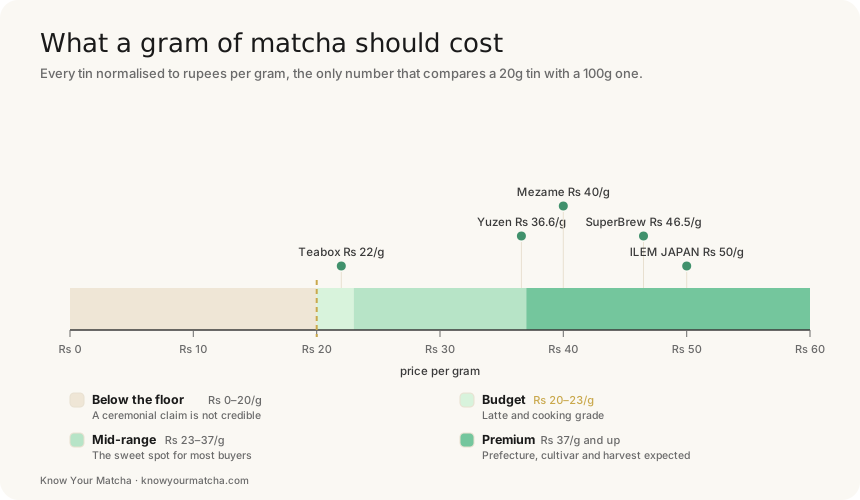
1. Price per gram, not price per tin
Tin sizes vary from 20g to 100g, which makes headline prices useless for comparison. We normalise everything to rupees per gram. It is the single most clarifying number in matcha, because it exposes the gap between what a tin costs and what it contains. Below roughly ₹20/g, a ceremonial claim is not credible for Japanese matcha once import duty, cold chain and packaging are accounted for. Above ₹50/g you should be getting a named prefecture, a named cultivar and a harvest date, and if you are not, you are paying for the tin. The budget finder filters the full ranking by what you actually want to spend.
2. The disclosure score, out of six
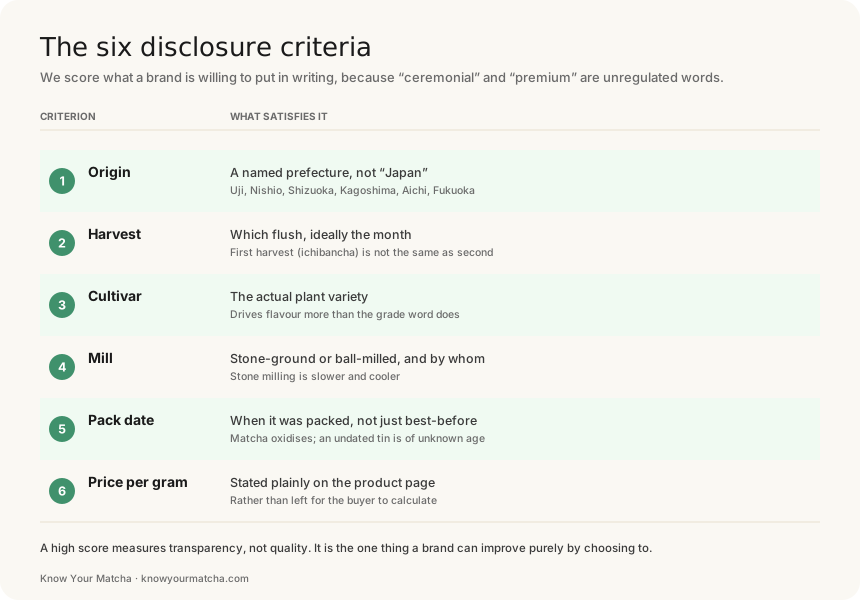
“Ceremonial”, “premium” and “AAA” are unregulated words that any brand may print on any powder. So instead of scoring adjectives, we score what a brand is willing to put in writing on its own product page. Six criteria, one point each:
- Origin — a named prefecture, not “Japan”. Uji, Nishio, Shizuoka, Kagoshima, Aichi, Fukuoka.
- Harvest — which flush, ideally the month. First harvest (ichibancha) is not the same as second.
- Cultivar — the actual plant variety, which drives flavour more than the grade word does.
- Mill — stone-ground or ball-milled, and by whom.
- Pack date — matcha oxidises. A tin with no date is a tin of unknown age.
- Price per gram — stated plainly, rather than left for the buyer to calculate.
A high disclosure score is not a quality award and we are explicit about that. It measures transparency, which is the one thing a brand can improve purely by choosing to. Several well-regarded brands score low simply because they have never published a prefecture. The full criteria, with what satisfies each, are on get featured, and the scoring protocol is in how we test.
3. The verdict, and who it is for
No brand suits everyone. A bold Kagoshima matcha that survives milk is the wrong purchase for someone who wants delicate usucha, and the reverse is equally true. Each verdict names the drinker it is for and the drinker it is not for. If you do not yet know which you are, start with the best matcha to buy first time, or answer three questions in find your matcha. For the flavour differences that follow from where a tea is grown, see the regions of Japan.
Are you a brand? Review is free and rank cannot be bought. See how to get featured and the six disclosure criteria, or send us a correction.